
PLANTING
Site Selection and Preparation Select a site that provides plenty of air circulation, good soil drainage, and ideally, at least 6 hours of direct sun daily. Dig the soil to a depth of 18” and mix in organic matter such as Chalet Leaf Mulch, cotton burr compost or dehydrated manure. The ratio should be 1 part organic matter to 3 parts soil. This is also a good time to mix in a starter food with beneficial soil microbes such as Espoma Bio-Tone Starter Plus, Dr. Earth Root Zone Starter Fertilizer (granular) or Bonide Root & Grow Plant Starter (liquid).
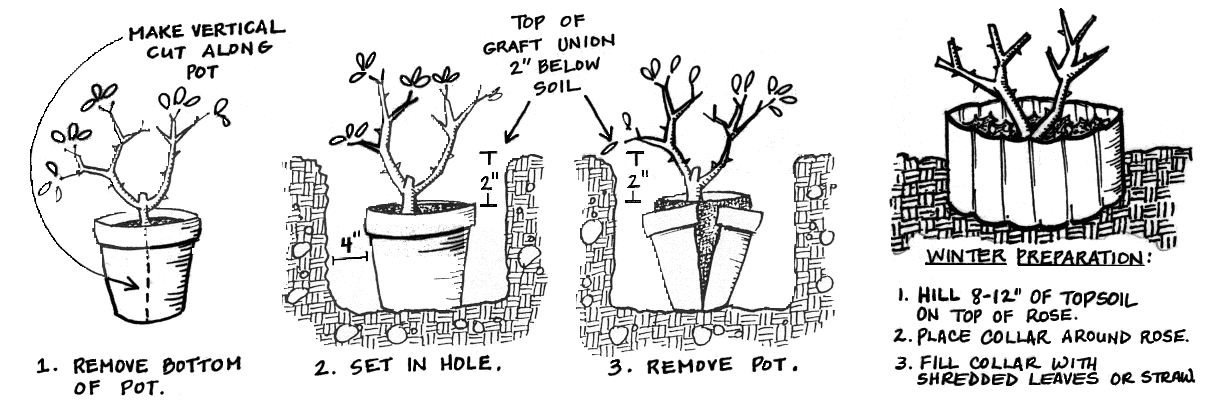
Planting Roses should be spaced 24 to 30” apart or more. Dig the hole wide enough to easily fit the root ball. Depth of the hole depends upon whether the rose is grafted or own root. Roses in the catalog without “OR” (own root) at the end of the description are grafted, mostly the hybrid teas and grandifloras, and should be planted deeper for winter hardiness.
- If grafted, the depth should be that when the root ball is set in the hole, the graft union (the knobby growth between the branches and the roots) is 1 to 2” below ground level. This is important in our climate to increase winter hardiness.
- If the rose is own root, the rose should be planted with the top of the root ball level with the soil surface.
- Set the rose in the hole, positioning as desired. Carefully slit the side of the pot and remove.
- Refill the hole with the amended soil and tamp gently to eliminate air pockets (again, be sure the graft union is 1-2” below the soil surface when planting is complete).
- Water thoroughly and apply a 1” layer of fine-textured mulch such as Chalet Leaf Mulch, shredded pine or pine fines.
Earth Friendly Naturals:
- Espoma Rose-Tone or Dr. Earth Rose & Flower Fertilizer Organic, granular slow release. Apply first in April after pruning or planting. Apply fertilizer again after the first flush of blooms and lastly at the end of July.
- Greensand Granular. Extends bloom and promotes winter hardiness. Apply twice per year, April and September.
INSECT AND DISEASE CONTROL OPTIONS
Synthetic:
- BioAdvanced All-in-One Feeds and provides long-term insect and/or disease control. Mix with water and pour. Apply three times per year at 6 week intervals starting in April.
- Bonide Rose Rx Systemic Drench Protects against insects and disease for 6 weeks. Mix with water and pour. Apply three times per year at 6 week intervals starting in April.
- BioAdvanced Insect, Disease & Mite Control Protects up to 30 days. Ready-to-use spray.
- Bonide Infuse or Immunox For the two most common diseases of roses, black spot and powdery mildew apply at 7-10 day intervals if weather is rainy and cool. Mix with water.
Earth Friendly Naturals:
- Espoma Earth-tone Insect Control Ready-to-use spray.
- Captain Jack’s Deadbug Organically controls insects. Ready-to-use spray.
- Bonide Copper Fungicide and Sulfur Fungicide Organically control disease. Mix with water spray and/or dust.
- Bonide Revitalize A new bio-fungicide that organically controls black spot and powdery mildew by triggering plants’ immune response.
- Neem Oil Controls fungus, insects and spider mites. Ready-to-use spray.
To learn more about these products please visit the Garden Shop Plant Health Care clinic.
WATERING
A thorough watering should be given at least once per week if there is not sufficient rainfall, or good drenching rains. Water 1” per week when temps are below 85° F and 1 ½” per week when temps are above 85° F. Deep, hand-watering in the morning is best. Be careful to keep water off the foliage, as this can spread disease. Leaf mulch, shredded bark or small chunk bark should always be used to conserve soil moisture, control weeds and improve bed appearance.
PRUNING
In spring before growth starts, prune roses hard (other than climbers, species roses and some shrub roses). Even if the canes are green, cut the stems back to an outward facing bud, leaving them 4-8” tall. What rosarians say about pruning hard and getting new branches from the bottom is true. You’ll also be removing overwintering blackspot spores that lurk in old leaves and canes.
In late fall, prepare hybrid teas for winter by cutting back to 18-24”. Do not cut back climbers, as they generally bloom on old wood. Shrub roses can be cleaned up and shaped in fall or you can wait until spring. There is no need to cut them back hard, unless you are doing a renewal pruning.
WINTER PROTECTION
The best method of winter protection is to hill the roses up with 8-12” of bagged topsoil or shredded leaf mulch. Roses should be hilled after we’ve had a few solid freezes and the ground is hard, generally around late November or early December. Rose collars are useful in keeping the soil and additional mulching material, such as straw or shredded leaves, in place. Protection should be removed in the spring when the danger of hard freezes has passed, generally around the third week of March.
Comments
0 comments
Please sign in to leave a comment.