
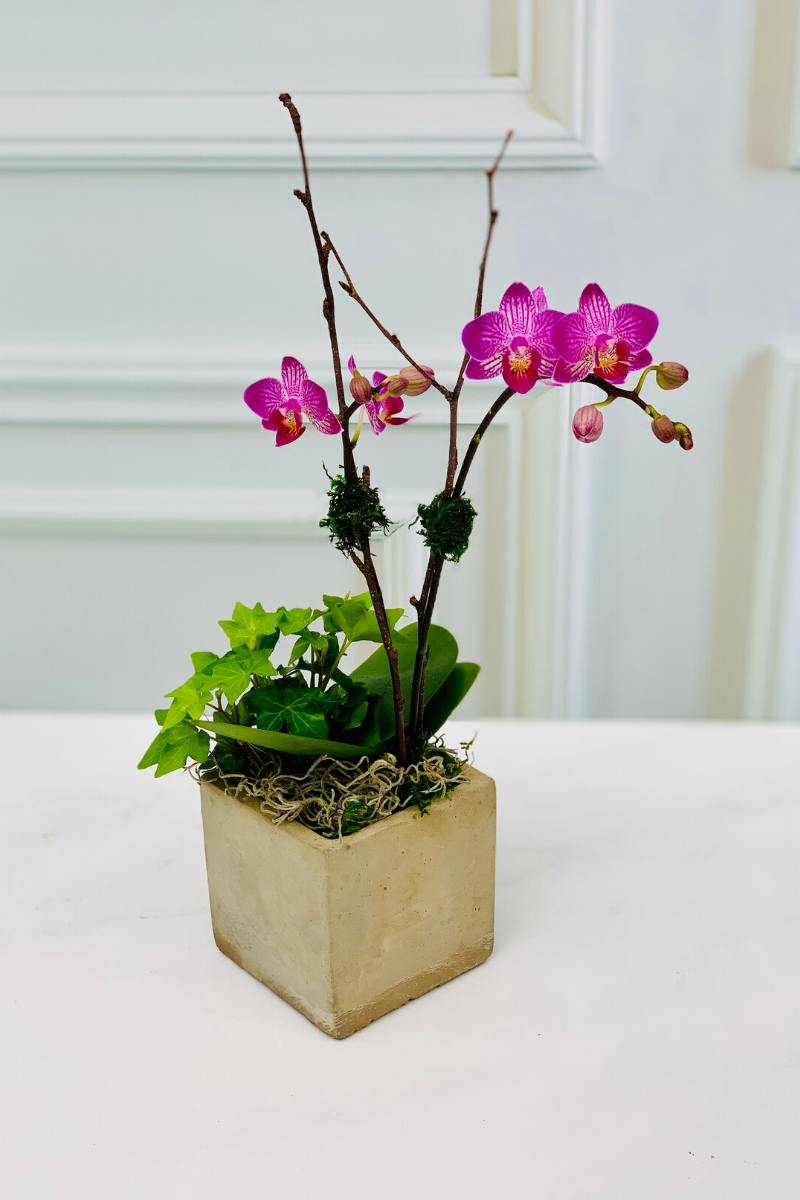
Mini Orchid Care (Phalaenopsis or Moth Orchid)
Location, Location, Location! Mini “moths” thrive in bright indirect light but they’ll crisp up and die in direct sun. If you have extremely low natural light, supplement with artificial light such as flourescents. Watch the leaves: in too much light orchids will turn yellow or red and even develop brown burn spots; in too little light, the leaves will be dark green but with no flowers. Keep temperatures over 55* and don’t sit near open windows or heat vents.
Water your mini orchid with one ice cube in the mossed pot every week. Orchid roots will rot if sit in too much water. Ice cubes provide a measured amount of water that gradually melts and sinks into the media. In excessively dry or hot conditions, add a little water mid-week. Orchids like humidity – mist the leaves every day or two or use a fill a pebble tray with water.
“Feed Me, Seymour” – To keep your orchid is from turning into Audrey from The Little Shop of Horrors, use a balanced fertilizer once a month, per instructions on the box. If your soil medium is bark-based, try a high nitrogen fertilizer (the first of the three numbers on every fertilizer box).
Fertilize your mini orchid once a month. Use a balanced fertilizer and mix it with water, diluting it down to half its recommended strength. If this fertilizer does not seem to do well for your plant, you can also try a high-nitrogen fertilizer, especially if you use a bark-based growing media.
Repotting
- Choose a container slightly larger than the one your orchid currently sits in. Mini orchids have fast-growing roots, so they need plenty of room. The new pot only needs to be large enough to fit the roots.
- Choose a growing media with large particles. Media with a base of moss and bark is superior to standard potting soil.
- Soak the growing media in water. Let the drenched media sit for 24 hours so that it thoroughly absorbs the water.
- Trim the plant spikes. Snip off green spikes 1 inch above the top node. Trim yellow or brown spikes 1 inch above the bottom node.
- Remove the mini orchid from its current pot. Gently grab the base of the orchid with one hand and the pot with your other. Tip the orchid to its side and slowly squeeze or rotate the sides of the pot until the clump of roots comes free.
- Brush off any planting media. Media breaks down over time and decomposed media can cause root rot. Remove as much old media as possible.
- Snip off dead roots. Dead roots are brown and wilted. Healthy roots are white or green and relatively firm.
- Scatter a little of the growing media into the bottom of your new container. You only need a little, since the mini orchid's roots should fill the majority of the container.
- Pot the orchid. Hold the orchid up so that the base of the lowest leaf dips below the rim of the pot by 1/2 inch.
- Pour the growing media around the roots. Press down gently to force it to the bottom and around the sides of the container. Periodically tap the side to help settle it. Continue adding media until the root system is covered, leaving the plant exposed from the bottom leaf up.
- Check the sturdiness. Gently lift the plant up by the stem. If the pot starts to slip, you need to add more media to make the orchid more secure.
- Refrain from watering for the first 10 days. Sit it in a warm location and mist it with a little water each day. The leaves should stay dry at night.
Repot your mini orchids every two years. Mini orchids may need re-potting as often as every one year, but some can even go as long as three years without any damage occurring. If your media starts to smell or if the roots of your flower look choked, you know it is time for you to repot.
Reflowering? After flowering, orchids need time to rest.
Blooming: Blooms last from a few weeks to 3 months, and re-bloom in cool temps up to 3 times a year. Phalaenopsis blooms from January through May.
Those new to orchids who receive them as gifts can become frustrated when, after the blooming and growing phase of the Phalaenopsis’ life cycle, it seems to die. Not only do the flowers drop, but the stem fades and starts to rot. By fall, it’s clear the leaves aren’t growing at all. The Phalaenopsis has entered its dormant period, gathering energy to produce a spike and a new bloom in winter. At this point, enjoy thePhalaenopsis as a green plant and it will reward your patience with a new bloom.
The life cycle of the Phalaenopsis orchid includes:
- Flowering Phase: late Fall to Winter in the northern hemisphere, keeping its blooms until Spring
- Growing Phase: late Fall through Summer
- Dormancy: Fall
Flowering Phase Care — January – May
What’s happening: Typically, households acquire Phalaenopsis while they are in bloom. With abundant filtered light and enough humidity, the Phalaenopsis will bloom for two months.
What to do: Unlike the Cymbidium, there is no need to fertilize a Phalaenopsis when it is blooming. Consider putting plant on a humidity tray (cookie sheet lined with pebble and filled with water) or spritzing daily in the morning.
Growing Phase (Post-Bloom) Care – June - September
What’s happening: The blooms die, but the leaves grow to gather energy for the plant to create a new bloom the next winter.
What to do: Once the bloom dies, owners have two choices: cut the stem down to the surface of the leaves or cut it only half way down. Those who cut the stem all the way allow the plant to focus on rebuilding roots and leaves which support the next winter bloom. Those who cut the stem only half way hope to get another bloom from the plant before winter. Some growers have gotten three blooms each year from their Phals. While this can work, it depletes the energy in the rhizomes (roots), impeding another winter bloom. Orchids that have been “forced” to bloom like this may have to rest for a year to replenish the energy needed to bloom again.
Fertilize with high nitrogen (30-10-10) fertilizer twice a month. Keep potting medium moist but not soaking.
Care of Phalaenopsis Orchids When Dormant – Sept - January
What’s happening: Orchids’ leaves stop growing so that plant energy can focus on roots instead.
What to do: When fall rolls around, give your orchid a rest by putting it in a cooler room with lower light. Without a cooler, dry rest, it may not bloom again. Putting the plant by a north-facing window with no direct sun for one to two months works well. If after six weeks no new stem has started, consider putting the orchid in to a room that remains below 60°F to “force” a new stem and use a high phosphorous (10-30-20) fertilizer to promote blooming in January. The orchid needs to get some inkling that winter has come and gone. When the new stem begins, return the orchid to the warmer area.
Repotting Phalaenopsis
What’s happening: When pots become root-bound and potting medium seems to have broken down, plants need more room and a fresh start, often every 18 to 24 months. The best indicator may be that cramped: non-aerial roots growing out of the potting mix.
What to do: Plants should be re-potted with new sphagnum moss or other Phalaenopsis potting mix. Choose a pot just one inch wider. Be sure to use lightly moistened, but not soggy, moss when re-potting.
Materials: medium fir bark; sharp, sterilized scissors or secateurs; pot just one inch larger than original (“over-potting” can reduce bloom initiation and growth);. Because the Phalaenopsis is an epiphyte, use a clay pot that allows for air transmission. You may even want to consider pots with holes like those in the illustration here.
- Gently pull the orchid from the pot and shake loose the remaining potting mix.
- Trim any dead or rotting roots.
- Pile a cone of potting mix in the bottom of the new pot and drape roots over that.
- Fill in with potting mix. The base of the bottom leaf should be at the surface of the medium.
- Water sparingly until new roots start. Wait one month before fertilizing.
Comments
0 comments
Please sign in to leave a comment.