
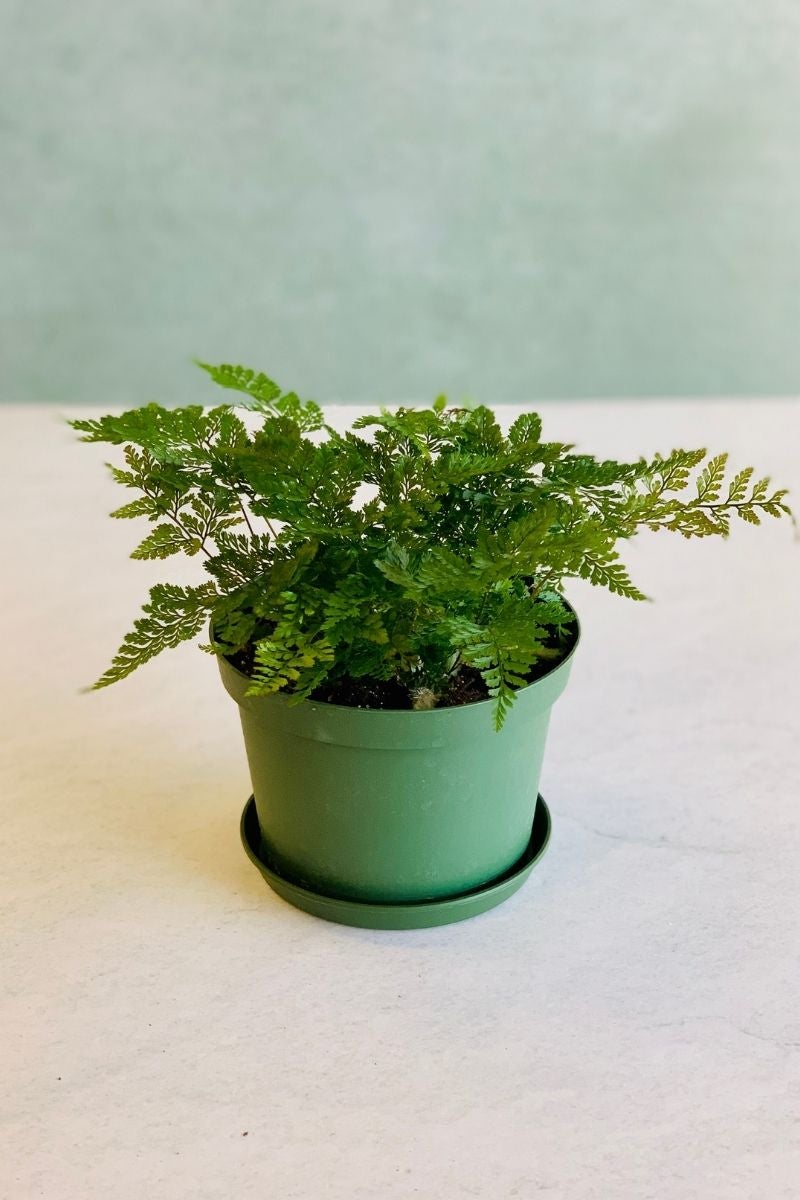
Taxonomic Name: Davallia fejeensis
Wood Fern Family
Nonflowering Herbaceous Plant
At maturity, this lovely native of the Fiji Islands produces not only lacy, dark green leaves, but also long, furry, tan rhizomes (creeping stems) than can entirely surround the plant's pot. To some, this makes the fern all too reminiscent of a giant spider; to others, it makes the plant a splendid conversation piece. Despite its delicate appearance, this species is one of the hardier ferns used indoors.
In its native habitat, the rabbit's-foot fern is an epiphyte--that is, it grows on tree branches and trunks rather than in the soil at ground level.
How to Care for Your Plant:
LIGHT: Bright indirect sunlight is best; such as near an unobstructed northern or eastern window. Your plant may also tolerate bright artificial lighting, at least for a few months.
WATERING: Water as soon as the top inch of the plant's potting medium feels dry. If the surface is completely covered with rhizomes, pick up the plant in its pot. If it's considerably lighter than it is when it's sopping, it's time to water again. Place your plant under a mild stream of slightly warm water for two or three minutes. Then let the plant drain thoroughly.
FEEDING: Apply plant food only when the plant is growing actively, and then do so sparingly. Use a high-nitrogen (high first number) houseplant fertilizer applied at half the concentration and frequency listed in the product directions
SPECIAL CONSIDERATIONS: Like almost all ferns, rabbit's-foot ferns need high humidity. Consider placing a water-filled gravel tray under your plant (if it isn't in a hanging basket), or place the plant near a room humidifier. If you repot your plant, keep in mind that it prefers to grow either in orchid bark (fir bark) or pure sphagnum moss. Your fern can also be mounted on a backing of sphagnum moss affixed to a wooden slab.
Comments
0 comments
Please sign in to leave a comment.